Adding the setting lists for the 2019, 2020 and 2021 690 SMC R now.
I've found them, finally. 


Adding the setting lists for the 2019, 2020 and 2021 690 SMC R now.
I've found them, finally.
If we are honest, and everyone who has a little idea about the 690s, knows that the new models are completely inferior to the "old" in terms of quality.
It really is ??♂️
I'm a simple man, I see someone bashing new KTMs I press like. 
I was just mentionning it for clarity in case somebody reads this in the future that's all.
The exception is the 654cc Duke Bj.10 + 11, which also had the sensors of the 690cc mopeds on it
If I can help, I've had tons of problems with these so ... I've come to know them a bit unfortunately ... 
Only the 690 SMC 2011 has the same throttle body as the 2012 and 2013 690 SMC R + ENDURO R (the blue plugs oriented forward).
+ 690 DUKE R 2010 and 2011
+ 690 DUKE 2011
+ 690 ENDURO R 2011 (there's no "standard" ENDURO in 2011, only the R).
The 2010 models have the same throttle units as the previous models.
Thanks 690erTimmy for reporting back, I've never heard about that crack until now.
Don't hesitate to test things, with fork height, clickers etc if you know were you've started and don't like a setting then just go back to the previous setting. :)
Do not overtighten the lower triple clamp + axle bolts.
This is one of the most critical part + make sure you get the fork's alignment right.
I encourage you to watch these 2 videos:
1) https://youtu.be/_B4zb2dfijw
2) https://youtu.be/DYHV78tWs1c
Nota:
On our bikes the "captive" fork leg is the left side (with the 27mm nut), not the right side like on this RSV4 but it's the same principle, just the other way around. ;)
Refer to this video for installing wheel / fork legs and brake caliper because just like on our bikes it has a radial foot and brake caliper.
I hope I've helped you in some way. 
Sorry there was an error in my text, 1st part was correct, 2nd part (bold text) was wrong I must have been more tired than I thought. 3rd part was correct though... Voilà.
Let's fix this once and for all (my fault) 
Offset 34mm (factory setup): a bit less stable everywhere / a bit more flickable
Offset 32mm (alternative) : a bit more stable everywhere / a bit less flickable
Geometry and suspension changes are always a trade-off.
Conclusion:
If I were you I would stick to 34 mm, get used to your new suspension + tires and start to play with your fork's height in the triple clamps.
Especially because you've said: "in turns it seems to be like i have to force it into the turn or better say put effort in it"
To counteract that you can lower the front of the bike by sliding your fork legs up in the triple clamps.
Go in steps of 2 or 3 mm. ;)
At each step the force you have to put in the handlebars to put it down + keep it down will decrease.
If the bike starts to go down very sudenly or "falls on its own", then go the other way, either a full step or half a step.
If you change brands or models of tires you'll have to do that once again, re find that sweet spot.
Same thing if you increase preload in the back.
It's been a long time since the last time I've had an SMC's steering head in my hands but yes I believe if it's at the back then it's 34mm, if you haven't messed with previously / are the first owner or if you are 100% sure about the service history then yes it's the factory set-up with the marking at the back.
For your O-ring problem, did you get this kit? ---> 00050000930
This kit goes on many many bikes so it's possible that some of these parts are only for EXCs or other bikes for exemple.
Side note, the official spareparts finder doesn't show THAT O-ring you've mentionned (on your printscreen).
It only shows on SMC R 2012 + partsfinder.
Are you sure there's a recess under the upper triple clamps to host this O-ring?
Both bikes share the same repair kit btw ---> 00050000930 (again)
SMC (2008 to 2011)
pasted-from-clipboard.png
SMC R 2012 +++
pasted-from-clipboard.png
"From memory i can say that i was always satisfied with my bike but in turns it seems to be like i have to force it into the turn or better say put effort in it"
Did the guys at the suspension shop end up putting a stronger spring in the back or softer springs in the front by any chance?
Or was it just hydraulics change?
How much do you weigh?
It is really is a shame + I'm almost sure it's not even mentionned in the owner's manual. :(
For the rest I'm sorry looks like my long speech + my experience got you confused! It's the exact opposite.
"If i change the offset to 32mm it becomes more agile in tight turns and less stable at high speeds, right?
I also get better feedback in comparison to the 34mm option?"
If you change to 32 mm offset you'll have more stability everywhere.
You'll not necessarily notice the lack of flickability / turnability (if that's a word), this is my opinion backed by my experience with this + what the guy on SupermotoJunkie said:
"The bike still will instantly drop into any turn..."
And, again, that's what I've noticed when going from my 2011 SMC with R/PP triple clamps (set on 35 mm offset) to another SMC with OEM triple clamps set on 34 mm offset.
Btw both bikes are springed in the back for a heavy guy (I'm around 112/113 kg in gear as is my friend) and both have the same job done in the forks, same oil, same simmerings, both chassis are greased once per year etc, so they are very very close.
With another SMC springed for a 80kg guy I wouldn't have said that because the bike would have been completely collapsed at the rear with my weight therefore changing the geometry dramatically.
Comparison would have been useless.
"Offset 34mm (factory setup): Less stable everywhere / a bit more flickable
Offset 32mm (alternative) : More stable everywhere / a bit less flickable
Take a look at the gif, when it switches to the smaller offset (at the top, in the triples) it gives a bigger trail number on the ground --> Imagine a Harley or a sand bike! :D
When it switches to the bigger offset, it gives a smaller trail number on the ground --> Imagine a sportsbike or trakc oriented supermoto.
This is pure theory though, as I've said just before passing from 35 to 34 I didn't notice the lack of flickability or anykind of lazyness in the steering inputs, bike felt more planted everywhere.
So in the end I was faster everywhere but more relaxed at the same time, even in very slow and tight stuff, I live between the Jura and the Alps.
I have never tested 32 mm on a 690 SMC set-up properly for my weight.
PS: I find the explanation a bit confusing both in French and English, maybe they are better in German?
By "fast race courses" they mean "high speeds" like a gp track, not a go kart track.
My apologies for answering in English.
34 brings more "nimbleness".
32 brings more "stability".
From the factory they come on 34 mm offset.
Caster is fix but you can modify the offset, that changes the trail (distance on the ground from center of the wheel to the projected line of the steering axle).
It moves the front end (forks + wheel) further or closer from you, this indeed changes the wheel base but this is not the main goal here, it's more like a side effect.
For example:
I personnaly like the 34 (from the SMC) MORE than the 35 from the R (I've had the R / PowerParts triples for a long long time but I don't really like them, everytime I jump on an SMC I prefer it, I'm gonna look at replacing mine (+ I hate the anodized orange).
I find it to be better even in slow curves, hairpins when you throw the bike from side to side quickly.
Gives much more feedback + grip so you end passing faster than with the "quicker steering" set-up so it counterbalances it.
There's a lot of psychology and feeling involved in geometry changes.
Sometimes you gotta make a counter intuitive change to bring back confidence and feedback.
Anyway I encourage you to try it out for yourself, only a few people have tested the 32mm offset.
But try to make 1 change at a time, if you replace the tires + service the forks + change the offset + change the height of the forks in the triple clamps + change preload in the rear at the same time it becomes pointless. :(
BACK IN THE DAYS --->https://www.supermotojunkie.co…set-on-the-690-smc.70063/
Here's an animated picture of the change in triple clamps offset.
This comes from the powerparts' triple clamps manual, it's the EXACT same shit as the 2012 + SMC R triples (also same system for previous generations) but it was never explained in the manuals as far as I'm aware. Shame.
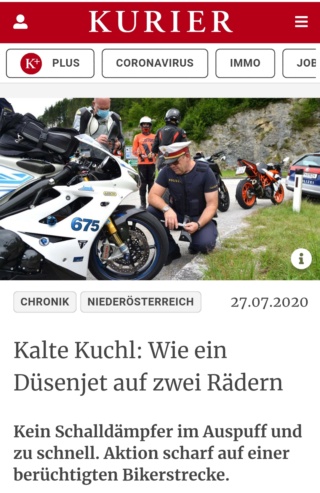
I thought only Swiss cops did that.
I was wrong.
Sad...
Also this week I've had the chance to get an SMC + an SMC R (250 mm / 2012 + 2013) forks apart at the same time so I've gathered a few infos that are gonna come useful at some point, + more info the the excel tables.
In a near future I would like to add links to the text and titles so people can directly open a picture / technical drawing online and immediately get what I'm talking about or how I did the drawing etc.
Sorry for the poor quality pictures.
Updated excel tables soon, probably during the next week.
690 ENDURO R (19/20/21) shock.
Interesting, to say the least.
Shock travel (setting lists) is 100 mm.
Lately a friend of mine and I have been working on his 2021 690 ENDURO R to stretch it to 300 mm front + rear (front swapped for an old SX CC forks), so we've been able to gather some cool infos.
We couldn't believe the bump stop was at 50% of the total travel so went further because as you know the wheel moves through an arc.
We took some measurements with the spring removed etc and the shock and it looks like it touches the bumper at ~148 mm of rear wheel travel (59%).
On older 690s, EXCs, SXs etc, even today's 690 SMC R the bumper is around a 1/4 (and sometimes a bit more) of the total travel of the wheel/shock.
I've got a disassembled SMC shock, I'll try to put it together without the bumper and spring when I have time to see what the real total wheel travel is and draw a graphic for the linkage, that would be interesting.
Still looking for more data here, don't know if we've missed/forgot something here.
Goal: 300 mm wheel travel front and rear.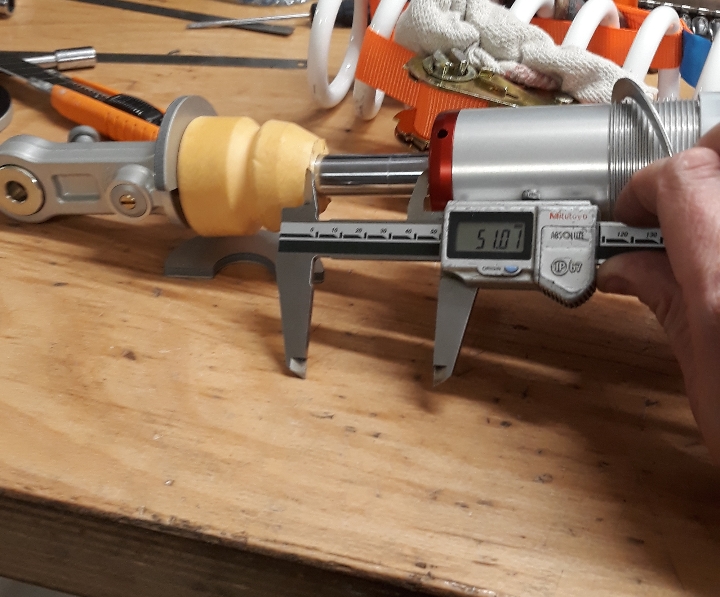
Thank you for sharing your experience with the 690 engine, always interesting.
Alles anzeigenBasically I think you are right, only whether the new locking washer is really better than the old one remains to be seen.
I have the thrust washer inside and was already thinking about putting the new locking plate on the holder in order to install it the next time I have the clutch outside again, but personally I still like the thrust washer somehow.
You can use it again and again and when I think about how much effort / breakaway torque is necessary each time to loosen the glued-in coupling nut, which is tightened to 100Nm, I honestly don't worry that it will someday work itself out could solve.
Why KTM has not written out the new locking washer instead of the thrust washer in all models in the spare parts catalog, I do not fully understand, but as I said, in my opinion it will probably be relatively irrelevant which of the two is installed .
It is simply important that you work cleanly, then the coupling nut should not be able to loosen by itself.
If my adventures / failures can help.
I have seen some come loose even with loctite 243 therefore I don't trust loctite 243 for things like big nuts that hold engine or gearbox shafts anymore etc.
I've even seen the left threaded nut come loose (on the right side of the crankshaft), not even mentionning the flywheel, so I've become paranoïac with engine shafts.
When I ordered my SIGMA clutch the instructions specifically asked for Loctite 620, not the 638 but the one with both the highest T ° and torque resistance, the 620.
That was hard to find, and a bit expensive but at least it works, you really gotta heat it alot for it to come loose.
Maybe the 620 is overkill, I'll never know, the pot I bought will last until the end of times ...
Loctite 620 / Varybond 16-20 and never think about it anymore. :cheers:
I have updated the setting lists (dropbox link) some of them were missing, I've added the ones for the 2019 and 2020 690 ENDURO R.
Looks like the 2021 model has different part numbers for both forks and shock, I haven't investigated more.
Still looking for the setting lists for the 2019 and 2020 690 SMC R, apparently, again the 2021 model has different elements than the 2 previous models.
Poskitt's frame has been reinforced, although he's keeping the exact spots secret (he makes a living out of this).
I bet it's reinforced around the steering stem + where the shock attches + at the back where the tank is attached.
His frame is also modified to accommodate the 450 RFR rear tank, I believe the reinforcements took place at the same time.

Thanks this is a good hint. And tracable for me. Because of the known 75kg KTM Standardrider it is a good idea to increase the preload at first: L
After measuring a bunch of KTMs, I don't take KTM's "standard weight" for granted anymore, at least with the experience I acquired with the SMC and SMC R that I've adjusted myself and a 701 Supermoto.
I have no experience with the ENDURO, I have one 2010 ENDURO R in my shed for now but that's it, as I have said earlier, I have no real world experience with the 2019/2020.
If I take the SMC for example, the front to back weight distribution and springs matching is pretty good for a 80 kg rider. But since the 2012 SMC R it has been worse every generation.
Each generation saw the spring at the back becoming softer and the springs at the front becoming harder. So the bikes end up beeing mismatched with a stiff front end.
Not even mentionning the loss in total travel and poor geometry resulting from that, especially at the rear with the swing arm getting flat as the rider sits on it.
SMC (265 mm): 5.2 N / mm front / 85 N / mm back
SMC R 2012/2013 (250 mm): 5.3 N / mm front / 80 N / mm back (later 2014 ---> 2017 went for 215 mm front)
SMC R 2019 +: 5.3 N / mm front / 75 N / mm back (215 mm front / 240 mm back)
Some 701s even have 5.6 N / mm front springs with a 75 N / mm spring at the back ... : think:
Of course valving + geometry also affect the overall response, even static, so you can't only take the springs for granted.
Optifix also mentionned the stiction in the SKF seals and yes this is a huge problem.
For road going bikes I remove the springs on the scrapers (dust seals), almost eliminates friction, remember most road bikes don't have a spring on the dust seal, it's just a simple "cover".
This is not doable for an enduro bike, even for dual purpose in a dry environment.
Anyway, what I wanted to say is, don't take the target weight for granted, measure, measuring tapes don't lie.
Too soft spring in the back make the front seams harder than it is, because the geometry is altered, the fork elongates when you sit on it because the back collapses so much.
"Chopper effect"
Soft and hard at the same time, worst feeling there is when riding a bike +++ lots of weight transfer when braking (because so much sag in the back), so you end up closing compression in the front to avoid that but it only makes it worse.
That's just an example, I'm not saying it's the case here.
Only measuring sags can tell what's going on with his bike.
Thank you for your answer. My weight is about 105-110kg with clothes.
Okay, I weigh the same, but I don't have access to a 2019/2020 690 ENDURO R unfortunately, I went to my dealer this afternoon to order some parts but the enduro they had was gone, sold.
Sorry I can't help any further. :(